Showing posts with label technology. Show all posts

Sunday, February 27, 2011

HHS and Data and Technology, Oh My!!

Last week I had the pleasure of attending a talk called, "Unleashing the Power of Open Data to Improve Health" organized by The College of Physicians of Philadelphia-section on Public Health and Preventative Medicine. The speaker was Todd Park, the Chief Technology Officer for the US Department of Health & Human Services (HHS). I have to admit, I was expecting something a little dry (having received my fair share of power point overload at government sponsored presentations). Wow- was I surprised to find Mr. Park on a wireless microphone running up and down the aisles engaging members of the audience!

The presentation focused on how HHS is living up to President Obama's "Open Government Initiative", which promises to have a "system of transparency, public participation, and collaboration". In terms of health data, Mr. Park said let's stop making people find data. Instead, let's "make data find people". In order to develop channels to help data find us, HHS has been engaging leaders from many areas of popular social media and technology (e.g., YouTube and Smart Phone application development). The government team has been sending the message "the data is yours...let's see what you do with it". In order to get the creative juices flowing, HHS has held and continues to hold "Health 2.0 Developer Challenges". The most current being the "Go Viral Collegiate Challenge" which calls on multidisciplinary teams from colleges and universities to develop a web or mobile application to address a significant health problem facing their communities.

Check out some examples of data applications produced through the use of open government health data:
  • Community Clash: An online card game that engages you in a discovery of your community's health and well-being status and let's you see how it compares to other communities in a head-to-head clash. (*Warning- apparently this game is incredibly addicting!)
  • Asthmapolis: A device that uses global positioning satellite technology (GPS) to determine the time and location when an asthma inhaler is used. The data is then stored on a server. The user can use this device to track asthma symptoms, triggers, and medication use- which could lead to an identification of environmental or other factors which improve/worsen their condition.
In addition to these challenges, HHS has also launched multiple websites to assist with the dissemination of this open health data. For example, HealthData.Gov and HealthIndicators.Gov. While this is all fabulous (and I really enjoyed looking at the challenge applications), how is this initiative being evaluated? Is the ultimate goal just about numbers? Does HHS just want to increase the number of people/organizations that are using health data? Do they just want to increase the number/types of data sources they can make available? Or is there some evaluation of the quality and accuracy of what is being produced? The challenge application website is sure to point out that the applications were not produced with federal money and therefore the government does not endorse them. But are they somehow creating an inventory of the applications and evaluating their effectiveness? Do we know which ones are actually increasing knowledge and changing behavior? Are we learning from the ones that do not? I applaud all the excitement around this initiative, but as always- I'm interested in seeing the outcomes. How will this initiative, which "unleashes the power of open data" actually improve health"?

Tuesday, November 23, 2010

Text Messages and Public Health: Can They Remove Barriers for "Calling" 9-1-1?

Text messages are a great time saver. You do not have to have a long conversation with someone...instead you can just send a quick message like "I made it home safe!" or "Can you pick up milk on your way home?" These text messages work well to support our busy lives, but can they also be incorporated into effective public health interventions and systems?

This week, the Federal Communications Commission (FCC) announced that it is looking into letting citizens report crimes via text message. An article posted by Wired discusses the possibility and highlights some of the "barriers" that this new strategy could help to address. First and foremost, it could allow citizens to report a crime without being overheard if they were in dangerous situations (e.g., kidnapping, robbery). The FCC specifically pointed to the 2007 shootings at VirginiaTech and reported that texts could have allowed emergency personnel to respond more quickly and with a better understanding of the circumstances inside the campus buildings.

While at first glance, it may seem surprising to use text messaging for 9-1-1 reporting (due to potential logistical considerations and challenges), it would not be the first time that texts were being integrated into public health interventions and emergency response systems. For example:

  • Text messages are used to disseminate key health messages to various priority populations. E.g., The Text4Baby campaign allows mothers to self select into their program by texting "Baby" to the program number. The mothers then receive weekly text messages (timed to their due date or baby's birth day) regarding key health issues for their babies (e.g., nutrition, immunizations, etc).
  • Many workplaces and college campuses have signed up for emergency response systems that will send out automatic alerts to email and phones (via text message) during a crisis (e.g., shooter on site).
In the case of using text messages for "calling" 9-1-1, I wonder about how texts could influence a well documented social psychology barrier to calling for help. Those of you that took a social psychology course in college may remember the name "Kitty Genovese". She was a woman who was murdered outside her home in Queens, NY in 1964. At least one dozen people heard or observed her attack (lasting approximately 30 minutes), but there was much delay in anyone calling for help. A NY Times article running two weeks after her death was entitled, "Thirty-Eight Who Saw Murder Didn't Call Police". This case is widely discussed as an example of the "Bystander Effect", which is used to explain why many people do not help in emergency situations when others are present. Some hypotheses about the effect are that we just do what others are doing (i.e., nothing to help), we assume someone else is already calling/helping, or we assume that others are more qualified to help. Perhaps it is also too much trouble to call 9-1-1? They require a lot of information, we have to stay on the phone, etc. Perhaps a more "passive" option to report the information (like text messaging) would decrease resistance and the bystander effect?

In addition to the great potential with this strategy, there are also several barriers that must be addressed in the planning:
  • Costs (equipment, training, staffing)
  • Regulation and Oversight: Will text message support be required or voluntary at emergency centers? Who will conduct a formative and ongoing evaluation of the system?
  • Interpretation of messages: Operators will need special training to (quickly) interpret and respond to text messages. Texts are often written in short hand, so you would need someone very skilled to decipher them accurately. It may also be time consuming to support the texting back and forth that may be required to receive all relevant information from the "caller" in order to dispatch an appropriate response.
Even with the barriers noted above, it does seem like text messages are a viable option to consider in order to increase timely and safe 9-1-1 reporting. However, the 9-1-1 system will need to think critically to develop the type of infrastructure that can keep up with our ever changing and expanding communication technology.

Tuesday, October 5, 2010

Bullying: Is Technology Helping Us or Hurting Us?


Like many of you, my heart broke when I heard about the suicide of Tyler Clementi last week. Unsure of exactly how I wanted to focus my blog on this topic, I took a little time and read the comments coming through on Facebook and Twitter. I talked to colleagues and friends. And something that really struck me was that many people expressed that technology was the problem. All this new technology can only lead to bad things. Right? I agree that new technology has played a large part in our discussions around bullying the past few years. There seems to be an assumption on the part of the bullies that they can be protected by technology- that their identity can be kept "anonymous" in the cyber-world. Perhaps more kids bully online because it is easier to insult or hurt someone at that distance- versus right to their face. Of course, these hurtful comments or videos now have a much broader reach. They can be disseminated through the school, city, state, or even country in just minutes. And you can't take them back. I also think that technology is evolving so quickly that we don't always understand the new boundaries for privacy.

But even with all the new challenges and channels to bullying that technology brings, I still do not believe that it is the root cause. As a friend of mine tweeted this week (yes- Beth G you get a shout out here) "Thinking on the Tyler Clementi case. Tired of hearing that technology is to blame. I'm pretty sure Dharun Ravi and Molly Wei are, actually". Let's not forget the role of personal responsibility- I believe that gets lost when the blame falls squarely on technology.

So with all of that as a backdrop for this discussion, I decided that I wanted to focus my blog on how technology can also help us to combat bullying and help those at risk for suicide. Risk for suicide can increase among those who feel isolated and disconnected from resources. They can also suffer when surrounded by social norms that do not support help seeking for the resources that they need.

So I wanted to present these resources that have gone viral in just the past few days. I can't help but think about all the isolated kids/teens they may reach:

1. MTV launched an Iphone application to combat bullying called "Over the Line". Users can post a bullying scenario that they've experienced and other users can vote if it was "over the line". This has the potential to help promote positive norms/limits regarding how we treat each other. The peer support online may also encourage users to ask for help.

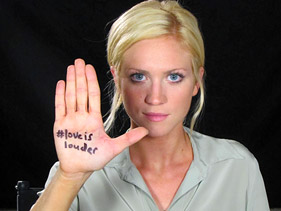
2. MTV was also involved in the launch of "Love is Louder". This "movement" has begun primarily in response to anti-gay bullying and suicides among LGBT youth. Viewers (and celebrities) can upload videos of support for these youth. It has been described as a way to channel the sadness and anger we all feel following these events. Again- this has the potential to build peer support among individuals that may be at risk. It also introduces celebrities or role models to support positive social norms.

3. Columnist Dan Savage has organized the "It Gets Better" campaign.
The goal is to reach out to lesbian, gay, transgender and bisexual youth who may be the victims of bullying and remind/assure them that things will get better. This campaign has also attracted many celebrity supporters telling their stories (e.g., Tim Gunn from Project Runway was featured on many of my friends' Facebook pages today).

4. Four days ago, Ellen DeGeneres posted "An Important Message" on YouTube regarding the recent suicides of LGBT youth. As of tonight, there had been 235,627 views of that video. She pledged her support and encouraged all of us to have zero tolerance regarding bullying and the loss of these kids/teens.

So that's the complicated story. Technology brings new prevention challenges to bullying. But it can also build peer networks and deliver resources to those in isolation. It can bring the voice of celebrities or other role models into the discussion, which can be a strong influence on kids/teens. I urge us not to write off all technology in light of recent events.

For example, if anyone reading this blog needs help- please call the National Suicide Prevention Lifeline: 1-800-273-TALK (8255). Their technology even allows for Veterans to chat with an online counselor. Amazing!

Sunday, April 11, 2010

iPads and other wireless technology: Forget the fun...will they be the next great public health invention?


iPad mania is sweeping the nation! It even made a cameo in my new favorite show, "Modern Family". In a recent episode, all Phil Dunphy wants for his birthday is an iPad. He is excited to use it for web browsing, eBook reading, and video watching. But what if it could also improve his health?
A great article in The Economist this week called, "When your carpet calls your doctor", examines how the convergence of wireless communications, social networking, and medicine will transform health care.

This concept appears quite realistic for several reasons:
  • Doctors are already using and comfortable with the technology. The article quotes a forthcoming report by the California Health Care Foundation that found that two-thirds of doctors are already using "smart phones" (a mobile phone with advanced capabilities such as Internet connectivity). Doctors are also used to turning to their computers and/or wireless devices for programs like Epocrates to review treatment information and decision making tools.
  • Wireless technology reduces treatment barriers such as the distance and/or availability of the health care provider. One example of the technology being developed is a device which will be able to contact a doctor when his/her elderly patient is about to take a fall in their residence. The article also quotes successful work being done in developing countries such as Rwanda and Peru. This work has expanded to public health programs in the United States, such as Text4baby. This is an educational program of the National Healthy Mothers, Healthy Babies Coalition (HMHB). Women who sign up for the service will receive free text messages each week, timed to their due date or baby's date of birth.
  • This technology is aiming to address barriers and facilitators of Behavior Change, not just an increase in knowledge! The focus soley on education to increase knowledge is the downfall of many public health programs. Knowledge alone will not change behavior. However, check out the programs from the company Virgin HealthMiles. They have begun using online social networks, through which co-workers or family members can cheer on or nag patients electronically, in order to encourage exercise or weight loss. The company is beginning to explore how to increase the level of social support and social/family acceptance that patients receive regarding their recommended treatment. Lack of support in these areas can often be a barrier to treatment success.
Of course there are still a few things that remain to be seen about the success of these eHealth programs. What are the privacy implications? Are smart phones (or similar wireless technology) widely available to the populations that most need these interventions (e.g., low socioeconomic status, the elderly, rural residents, etc)? What do my readers think?

Tuesday, March 9, 2010

Technology: Building Social Connections or Breaking Them Down?


Last week, a friend at work told me that she had given up watching TV for Lent. She said "every time I give up TV, my quality of life goes up". I thought of her immediately today as I read this new article in TIME, "Logged on, checked out...of relationships?" The article discusses a study (published in the March issue of the journal Archives of Pediatrics & Adolescent Medicine) which studied adolescents during two periods of time (1988 and 2004). The adolescents who spent more time watching TV or playing video games were more likely to report lower quality relationships compared with those who logged less screen time.
I find this fascinating because I have followed the debate among colleagues and friends regarding the increase in the use of technology and its impact on social connections. For example, kids that may be "outcasts" at school may find friends online. They may have hundreds of Facebook "friends". They may find lots of kids with similar interests by joining "groups" online. However, one has to ask, are Facebook friends "real"? I personally have 355 friends on Facebook, but would only consider about 10 of those people close friends in my day to day life. Is it worth it to focus your time and attention to online activities (as noted above) to the detriment of your "real life" relationships with friends and family?
In looking at how social connectedness can be a protective factor for things like suicide, the question has also come up: "Is it the quantity or quality of relationships that really count?" In research on college students, studies like Healthy Minds are beginning to indicate that it is the quality that counts. However, unlike my previous posts where it has been easy for me to take one side or the other...I'm torn about this issue. The authors of the above study were as well...they note that there is an obvious correlation between online activities and relationship quality, but the causal link is not clear.
Therefore, I believe it is probably some happy balance that is best. Facebook friends and groups are not all superficial and time wasters. People can connect (or in many cases, "reconnect") with friends and colleagues with shared histories or interests. I've seen Friends post a concerning or unsafe status and 20 people jump in with words of encouragement or offers of help...which is wonderful. On the flip side, it helps to turn the computer or TV off and enjoy the world around us...strengthen those connections with those we live with, eat dinner away from the TV, etc. And of course on that note, I'll log off. LOST starts at 9pm ;)