Tuesday, October 5, 2010

Bullying: Is Technology Helping Us or Hurting Us?


Like many of you, my heart broke when I heard about the suicide of Tyler Clementi last week. Unsure of exactly how I wanted to focus my blog on this topic, I took a little time and read the comments coming through on Facebook and Twitter. I talked to colleagues and friends. And something that really struck me was that many people expressed that technology was the problem. All this new technology can only lead to bad things. Right? I agree that new technology has played a large part in our discussions around bullying the past few years. There seems to be an assumption on the part of the bullies that they can be protected by technology- that their identity can be kept "anonymous" in the cyber-world. Perhaps more kids bully online because it is easier to insult or hurt someone at that distance- versus right to their face. Of course, these hurtful comments or videos now have a much broader reach. They can be disseminated through the school, city, state, or even country in just minutes. And you can't take them back. I also think that technology is evolving so quickly that we don't always understand the new boundaries for privacy.

But even with all the new challenges and channels to bullying that technology brings, I still do not believe that it is the root cause. As a friend of mine tweeted this week (yes- Beth G you get a shout out here) "Thinking on the Tyler Clementi case. Tired of hearing that technology is to blame. I'm pretty sure Dharun Ravi and Molly Wei are, actually". Let's not forget the role of personal responsibility- I believe that gets lost when the blame falls squarely on technology.

So with all of that as a backdrop for this discussion, I decided that I wanted to focus my blog on how technology can also help us to combat bullying and help those at risk for suicide. Risk for suicide can increase among those who feel isolated and disconnected from resources. They can also suffer when surrounded by social norms that do not support help seeking for the resources that they need.

So I wanted to present these resources that have gone viral in just the past few days. I can't help but think about all the isolated kids/teens they may reach:

1. MTV launched an Iphone application to combat bullying called "Over the Line". Users can post a bullying scenario that they've experienced and other users can vote if it was "over the line". This has the potential to help promote positive norms/limits regarding how we treat each other. The peer support online may also encourage users to ask for help.

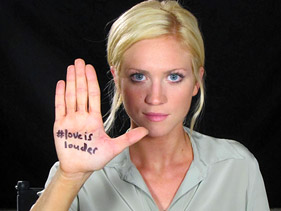
2. MTV was also involved in the launch of "Love is Louder". This "movement" has begun primarily in response to anti-gay bullying and suicides among LGBT youth. Viewers (and celebrities) can upload videos of support for these youth. It has been described as a way to channel the sadness and anger we all feel following these events. Again- this has the potential to build peer support among individuals that may be at risk. It also introduces celebrities or role models to support positive social norms.

3. Columnist Dan Savage has organized the "It Gets Better" campaign.
The goal is to reach out to lesbian, gay, transgender and bisexual youth who may be the victims of bullying and remind/assure them that things will get better. This campaign has also attracted many celebrity supporters telling their stories (e.g., Tim Gunn from Project Runway was featured on many of my friends' Facebook pages today).

4. Four days ago, Ellen DeGeneres posted "An Important Message" on YouTube regarding the recent suicides of LGBT youth. As of tonight, there had been 235,627 views of that video. She pledged her support and encouraged all of us to have zero tolerance regarding bullying and the loss of these kids/teens.

So that's the complicated story. Technology brings new prevention challenges to bullying. But it can also build peer networks and deliver resources to those in isolation. It can bring the voice of celebrities or other role models into the discussion, which can be a strong influence on kids/teens. I urge us not to write off all technology in light of recent events.

For example, if anyone reading this blog needs help- please call the National Suicide Prevention Lifeline: 1-800-273-TALK (8255). Their technology even allows for Veterans to chat with an online counselor. Amazing!

Wednesday, September 29, 2010

Evaluating 90210 & Public Health Interventions: My Perfect Fantasy Job


Cases in Public Health Communication & Marketing is an online, open-access journal (coming out of the George Washington (GW) University School of Public Health and Health Services) which focuses exclusively on case studies from the fields of public health communication and social marketing. The journal's mission is to promote the analysis of real-world experiences and practice-oriented learning. They have recently published Volume 4 (Summer 2010) which includes several case studies focused on Entertainment Education and the work of Hollywood, Health, & Society.

Hollywood, Health & Society (HH&S), is a program of the USC Annenberg Norman Lear Center, and provides entertainment industry professionals with accurate and timely information for health story lines. Funded by the Centers for Disease Control and Prevention (CDC), The Bill & Melinda Gates Foundation, The California Endowment, and the Health Resources and Services Administration's Division of Transplantation and Poison Control Program, the program recognizes the profound impact that entertainment media have on individual knowledge and behavior. These professionals (who totally have my perfect job!) focus on Entertainment Education (EE), which is a communication strategy that involves embedding health or social messages into entertainment programming that can influence knowledge and attitudes, and promote healthy behavior among television drama audiences. The two cases highlighted for the GW publication included a The Bold and the Beautiful (daytime soap opera) storyline which promoted bone marrow donation and a (new) 90210 (nighttime young adult soap opera) storyline which highlighted a main character with bipolar disorder.

What is really fantastic about the case descriptions (beyond the collaboration and prep work that went into creating these accurate and engaging story lines) was their discussion of how to evaluate their efforts. Evaluation is (unfortunately) sometimes an afterthought for public health interventions. Or evaluation is poorly defined as simply measuring satisfaction- "Did the viewers "like" the episode?" Despite the complexity of evaluating health communication efforts, these case studies were quite thorough. For example, with the 90210 episode, they looked not only at exposure (i.e., how many watched the episode or saw the accompanying PSA on bipolar disorder) but also at help-seeking behavior following the episode. They documented calls/contacts to their partners (e.g., SAMHSA Health Information Network and the Child and Adolescent Bipolar Foundation (CABF). The evaluators also collected qualitative feedback from volunteers and teens who visited the CABF online chat rooms after the episode aired. "As expected, visits to the chat rooms increased shortly after the episode aired. Remarkably, traffic and participation in the chat rooms continued for months after the episode and PSAs aired".

It is always validating to see that watching TV can be more than a mind numbing couch potato activity...it can be educational and essential for shaping and measuring social norms around important health issues.

Monday, September 13, 2010

Health Intervention Reality Shows: Are Participants Rescued or Buried Alive?

Last month I wrote on my Facebook wall "that hoarding show on TLC is both horrifying and fascinating". From the quick responses to my post, it is clear that I am not the only one feeling this way. Therefore, I was really interested in stories recently posted on the TIME website discussing how these types of shows can be harmful for the individuals that are featured.

There have been a slew of reality TV shows focused on staging interventions with individuals with a variety of mental illnesses/addictive behaviors. Some examples are "Hoarding: Buried Alive" (TLC), "Hoarders" (A & E), "Intervention" (A & E), and "Celebrity Rehab with Dr. Drew" (VH1). In one TIME article called "For Hoarders and Addicts, Drama is Trauma- Not Therapy", the author presents the argument that the needs of the mentally ill and addicts are the exact opposite of the formula of successful reality TV shows. Recovery for these individuals takes time and empathy and reality TV shows are looking for conflict and quick fixes within the hour allotted.

In all fairness (since I haven't seen all the reality shows in this category), I must say they are not all created equal. For example, A & E "Hoarders" seems to be much more of quick fix with cleaning crews clearing out houses over a two day period (which is very traumatic for the owners). In contrast, TLC's "Hoarding: Buried Alive" cleans out over a longer period and the individuals are more active participants/leaders in their own clean out. With the TIME article noting that effective clean outs for hoarding are a year on average, you have to wonder about the trauma of being confronted on camera about your "abnormal" behavior and then forced through a quick clear out. Also, the behavior of hoarding (or drinking or drug use) is usually just the tip of the ice berg, as it is a symptom of a larger problem. For example, I recently watched one episode of "Hoarders" where the woman shared that she began hoarding after surviving childhood sexual abuse. The therapist assigned to her clean out said "let's not talk about that right now". Therefore, I wonder about the long term repercussions of bringing out these emotions and not providing individuals with the support they need.

On the other hand, there could be potential positive outcomes from these individuals being featured on such a reality show. The primary outcome that I think of is access to resources. Many of the families/individuals featured are in great financial peril (often as a result of the money needed to continue with their addictions). The show is able to link them up with leading experts in their condition, offer ongoing care, assist them with legal concerns, etc. It remains to be seen whether these positives outweigh potential dangers.

Thursday, September 2, 2010

Can Foursquare get youth to "check in" to STD testing?


As technology and social networking continue to expand, it is logical to think about the connection to public health. We need to think specifically about its use among priority populations already using it- like youth. It has just been announced that Foursquare will team up with MTV for their "Get Yourself Tested" (GYT) campaign. I'll back up quickly for those that are not familiar with Foursquare. It is a mobile application that allows users to "check in" at locations in order to explore a new city, link up friends, etc. There is also a "competitive" nature to the application which offers "badges" and other titles to individuals which visit the most spots.

Foursquare and GYT have teamed up to offer the first cause-related badge for users who visit STD testing sites. The goal of offering the badge and allowing users to announce it in a public setting is to reduce the stigma of STD testing. This is a common public health strategy- to focus on reducing a specific barrier to a health behavior. In this case, planners are hoping to reduce stigma by normalizing STD testing.

The article does not mention how the program will be evaluated. It seems simple enough to track the number of people who obtain the GYT badge (which I assume is just based on self report). It would be interesting to have some kind of follow up with users to find out:

1. Why they decided to get tested (was it due to exposure to the GYT materials/foursquare badge?)

2. Was this the first time that they were tested? I.e., is this campaign actually initiating a new action among youth? Or is it only attracting youth that have already bought into this behavior?

3. Is there a certain demographic most influenced via Foursquare? How is this similar/different than the changes they are documenting using more traditional channels like PSAs/posters, etc?

I know many of my friends/followers are Foursquare users- what do you think of using the application for "causes" and other public health initiatives?

Monday, August 30, 2010

"Health Fashion" Police

It is the day after the Emmy Awards, so most of us have fashion on the brain and are eagerly awaiting E! Fashion Police. As a result, I thought it was very timely to discuss "Health Fashion". The idea came to me this weekend in two ways. First, as I saw new fashion merchandise (modeled by celebs like Jordin Sparks and The Jonas Brothers) in the form of "TXTING KILLS" thumb bands to reduce texting while driving. Next, I read a fabulous new article in the September 2010 issue of Health Promotion Practice called, "Undressing Health Fashion: An Examination of Health-Cause Clothing and Accessories".

The article provides a great overview of the history of health fashion, including its beginnings in 1953 with the first Medic Alert bracelet. It then proceeds to discuss the use of colorful ribbons to support causes (e.g., AIDS, deployed troops, etc) over the past 30 years. However, the authors really highlight the Lance Armstrong/Nike release of the yellow Livestrong wristband in 2004 as the event that created an explosion of Health Fashion and Cause Marketing.
Health Fashion is sorted into one of three categories:
1. Wearables: Worn by the consumer (e.g., Nike Livestrong wristband)
2. Usables: Items that are directly consumed or that utilize health fashion symbols in manufacturing/packaging/marketing (e.g., United States Postal Service breast cancer stamps)
3. Displayables: Items that are displayed in homes/offices/cars which use health fashion symbols (e.g., Swarovki pink ribbon holiday ornaments)

The article also does a nice job giving an overview of how this merchandise becomes a hot trend. It introduces the reader to Everett Rogers' Diffusion of Innovations theory and how innovators and early adopters (often well known/respected in the community) can disseminate messages or material throughout their community/society, etc. Many of you may be familiar with this theory after reading Malcolm Gladwell's "The Tipping Point".

However, the key question on this blog (and happily in the article as well) is: "Are these initiatives effective?" In order to make that call we have to define what we mean by "effective". The article points out that many campaigns (e.g., Go Red for Women) define their goals as raising awareness. Therefore, if they survey women pre and post campaign and they report an increase in knowledge of facts such as "heart disease is the number one killer of women"...then they can say that the campaign was effective. However, if they had defined their goals in terms of behavior change (e.g., more women will visit their doctor for yearly blood pressure checks), it would be unclear if their goals were achieved.

Another way "success" or "effectiveness" has been defined for health fashion has been focused on the revenue generated by the sale of these items. If the Livestrong wrist bands or Avon's "Kiss Goodbye to Breast Cancer" lipstick line raise significant funds for their charities, then we can consider them successful....right?

Here are some questions regarding effectiveness raised by the article...with my own two cents (okay- more like five cents) thrown in:
1. Are we achieving saturation point with the marketing of health fashion? Does anyone even know what color wrist band supports what cause?
2. How will increasingly knowledgeable consumers affect the sale of these items? It is much easier to find out what percentage of your donation/purchase is actually going to the charity vs. to the corporation.
3. How have social networking sites like twitter/facebook affected the adoption/dissemination of health fashion and cause marketing? Support for a cause can be almost instant and celebrities can quickly call on their twitter followers, which in some cases number over one million. Are consumers being as thoughtful/careful when it is so easy just to click their support?

What are your questions?

Wednesday, August 25, 2010

Teen Moms and Teachable Moments

For one terrible minute on Monday night, my remote control found itself on ABC Family's "The Secret Life of the American Teenager". The show is completely unrealistic in showing 15 year olds pregnant and parenting with the maturity and vocabulary of people in their 30's. However, my remote control has recently become stuck on a reality show of the same topic on MTV called "Teen Mom". Now this is quite a leap of faith for me, as I pretty much gave up on MTV after its early quality reality shows (Season 3 of Real World with Pedro, anyone?) turned nasty and staged and scandalous. But according to a recent NPR story, I am not the only one thinking that this new show has some value and "reality". The Kaiser Foundation has funded reproduction of the series so that it can be distributed to schools, non-profits, and social service organizations that are working to reduce teen pregnancy.

The educators mentioned above believe that "Teen Mom" helps create and capitalize on a teachable moment. This is defined as "a moment of educational opportunity...a time at which a person, especially a child, is likely to be particularly disposed to learn something or particularly responsive to being taught or made aware of something". One reason to buy into this theory is based on the idea that modeling is important. People learn from watching each other. What high school students see other high school students doing is very important. Therefore, seeing the realistic struggles of the four girls on the show could help them think about potential consequences of teen pregnancy. We see the relationships with their family or the baby's father crumble. We see them working and paying bills in addition to waking up at all hours to a screaming baby. We hear about how one girl lost the father of her baby in a car accident before the child was born...now she is a single mom.

Of course anyone who reads this blog on a regular basis knows that I need to mention that this show is being used in schools as an educational piece. And of course an educational piece is not a silver bullet because it cannot address all the complex risk factors for teen pregnancy which include things like economic disadvantage and growing up with teen parents yourself. However, I think it is a step in the right direction. It is definitely an improvement in the quality of MTV reality shows. It also shows these girls in a pretty "real" light without being preachy or fear-based. Check it out and let me know what you think.

Tuesday, August 10, 2010

The NFL is making pretty posters- but what are they doing to change the CULTURE of playing with head injuries?


Hot off the presses! Check out the new poster produced by the NFL which now hangs in every locker room in the National Football League. This poster represents a new effort within the sport to educate and protect its players from head injuries. However, I would argue that these strategies (and the others that I will outline) will not do anything to help the problem until a culture shift begins on the player level.
I was inspired to write this blog post after reading an editorial by Michael Wilbon in the Washington Post (thanks to my husband for making me a PTI fan). Mr. Wilbon compares these posters to the Surgeon General's warning that appears on each cigarette package. I completely agree- and they will be just as ineffective. Straight education and "fear-based" messages are not capable of changing behavior.

My first concern is regarding the layout and content of the poster itself. In any good health communication piece, you want the target audience to quickly and easily understand what you are trying to say and what you hope they will do after viewing the piece (i.e., what is the "call to action?"). The NFL poster fails in multiple areas:

1. It is not quick: It took me almost 5 minutes to read it thoroughly.
2. There are too many goals/calls to action (at least three by my count): 1- Education about the facts and symptoms of concussions; 2- How/why to refer yourself; 3- How/why to refer a teammate.
3. It uses some "fear-based" messages (e.g., head injuries can cause early onset dementia).

I highly doubt that this poster was tested with the target population (NFL players)- which is always the best way to produce effective health communication materials. Perhaps the players would have pointed out the obvious oversight that the photographs on the poster are not NFL players (but instead children and those playing other sports).

The posters are being rolled out in conjunction with other prevention strategies. For example, there have been policy changes (either under consideration or already active) regarding how quickly a player can come back after a concussion, how much contact/hitting can take place in practice, etc. They are also reviewing new data regarding the safety of different types of helmets and supporting a coaches committee dedicated to the discussion of player safety.

But what about the players themselves? Are they ready to sit out games? Will they support their teammates sitting out games? From many stories heard from the fields and locker rooms- players have not yet bought into this "new system". For example:

Last November (2009), Ben Roethlisberger of the Pittsburgh Steelers sustained yet another concussion. It was ultimately decided (by his physicians) that he could not play in a key game versus the Baltimore Ravens. The result- he did not receive support from his teammates. Hines Ward told the media that support in the locker room was "50-50" regarding if Ben should play. He talks about how other players have played (and would have played) through a concussion. He also discussed how they would lie to physicians in order to be cleared for play.

So while it is great to have committees and make posters, until the players are on board and feel supported by their teammates to put their health first (without consequence or retribution), these other measures will not truly be effective. A culture change must come first- and it must start with the players.